


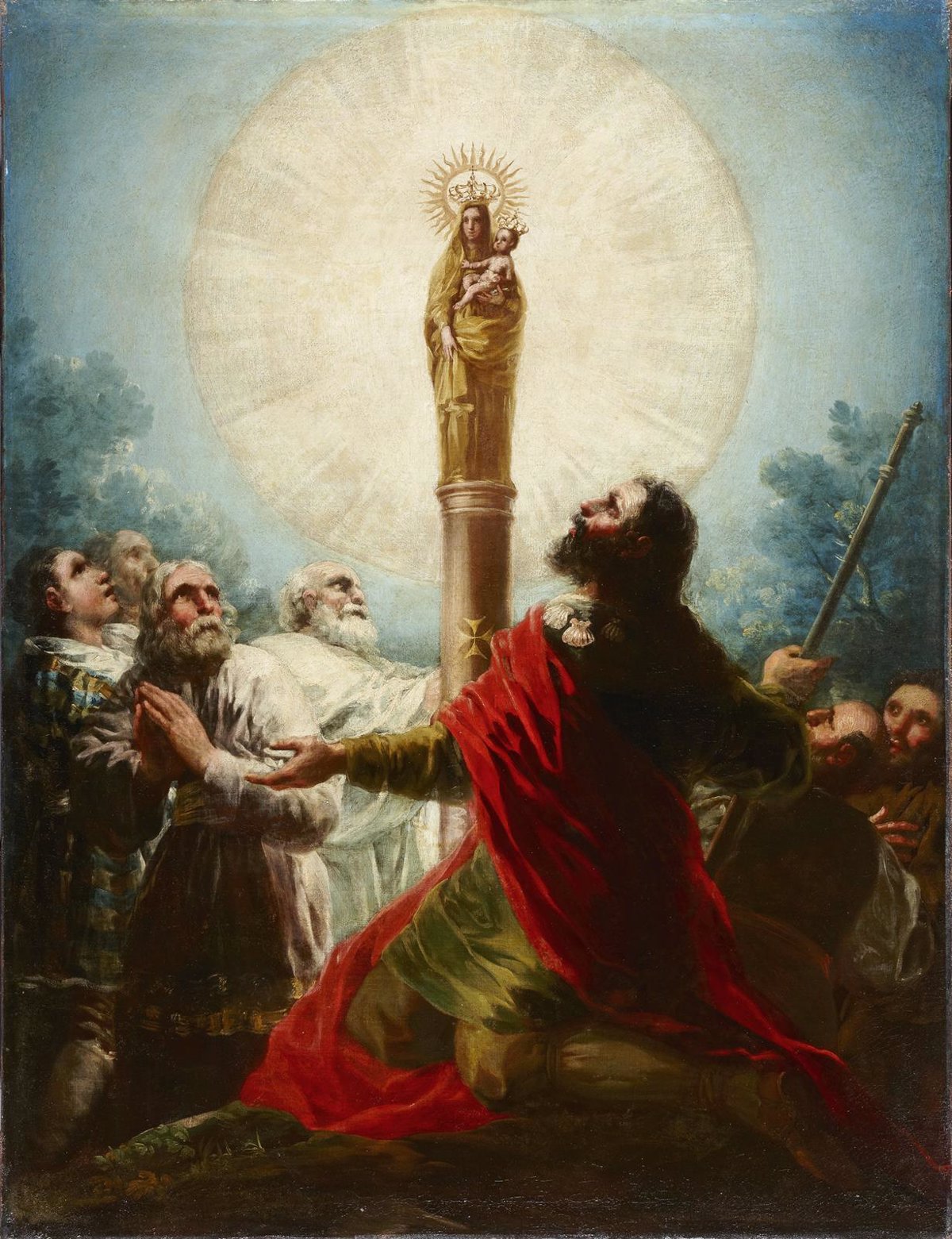
 Goya’s canvas doesn't discover a purchaser within the public sale of the Alcalá room –
[ad_1]
Goya’s canvas doesn't discover a purchaser within the public sale of the Alcalá room –
[ad_1]
The canvas ‘Apparition of the Virgin of Pilar to the Apostle Santiago and his disciples’, the work of Francisco de Goya and described as inexportable, has not discovered a purchaser within the public sale that the Alcalá corridor in Madrid has held this Thursday with a beginning value of Two hundreds of thousands of euros.
It's a large-format canvas (107 x 80 cm), which was a part of the previous Rosillo assortment and by descent to the present Madrid non-public assortment, and for which a beginning value of two million euros was established.
It's a completely documented work, which the Marquis of Lozoya already made recognized in 1951 in his article ‘Two unpublished Goyas on non secular themes’. The piece might be seen in 2012 within the exhibition of the Royal Palace ‘Goya and the Infante Don Luis the exile and the dominion. Artwork and science on the time of the Spanish Enlightenment’.
Subsequently, between 2013 and 2018, it has been a part of the everlasting exhibition of the Goya Museum in Zaragoza, on mortgage.
Goya was an avant-garde artist, at all times in search of new expressive prospects. He traveled to Italy, the place he was capable of research the masterpieces of the artwork of the classical period and of the Baroque masters and in 1771 he returned to Zaragoza receiving the fee to brighten the vault of the Coreto del Pilar Adoración del Nombre de Dios’, in 1772.
After this fee he achieved the status that may give rise to different pictorial commissions such because the cycle devoted to the Lifetime of the Virgin for the church of the Cartuja de Aula Dei in Zaragoza.
Presently his journeys to Madrid and his necessary leap to the Madrid courtroom are additionally recognized. The younger man from Fuentedetodos, aged 29, is summoned by Antón Rafael Mengs, Carlos III’s first chamber painter, to the Courtroom of Madrid.
THE CANVAS
From a technical and chromatic standpoint, based mostly on vivid and luminous tones, we will relate this work to the cartoons with themes of searching and fishing for the tapestries destined to brighten the eating room of the Princes of Asturias within the Royal Web site of San Lorenzo. del Escorial in 1775.
The theme of the Virgen del Pilar was chosen by Goya on completely different events. There's a pencil drawing of one of many pages of the Italian Pocket book (f.134r) and a small canvas, 56 x 42 cm, that he painted round 1771-1775, preserved within the Zaragoza Museum.
The great state of conservation of the work stands out, the restoration work of which was carried out within the workshop of the Prado Museum, simply earlier than the exhibition through which it was held on the Royal Palace in Madrid. The work is inexportable.
[ad_2]
0 comments