


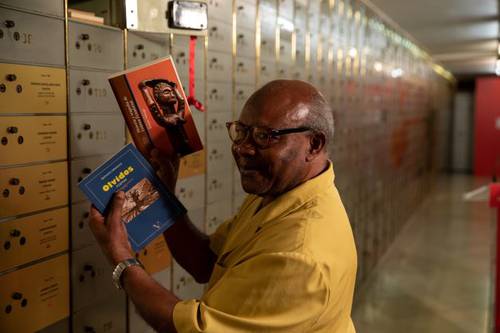
 Donato Ndongo deposits his legacy within the Caja de las Letras of the Cervantes Institute –
[ad_1]
Donato Ndongo deposits his legacy within the Caja de las Letras of the Cervantes Institute –
[ad_1]
Donato Ndongo deposits his legacy within the Caja de las Letras of the Cervantes Institute
Donato Ndongo is the primary African author to enter this limbo of literature and artwork positioned in Madrid.Photograph courtesy of the Cervantes Institute/ Miguel Alcalde
Madrid. Donato Ndongo is a journalist and author born in Equatorial Guinea in 1950, and yesterday he grew to become the primary African author to deposit a legacy within the Caja de las Letras on the headquarters of the Cervantes Institute. The mental selected the primary eight editions of his most necessary and consultant works, in addition to a sealed envelope with a textual content that had not but been revealed. My soul overflows with immense gratitude to confirm that this work and the trajectory that helps it are strong sufficient to arouse curiosity and never solely from mental curiosity, but in addition from a rising public in probably the most various cultural fields.
Ndongo declared.
Ndongo was born in a small village, Niefang, previously often called Seville of Niefang
, positioned on the foot of the Monte Alén Nationwide Park, one of many important biosphere reserves in Equatorial Guinea, which can also be the one African nation with Spanish as its official language. Ndongo himself is likely one of the most acknowledged African students of this language, with an extended profession as a author, journalist and instructor, he has even taught at varied universities in Spain, the US and Africa.
The Caja de las Letras is a part of the historical past of the Cervantes Institute, whose headquarters is the constructing of an previous financial institution, with its armored secure and the immense concrete and metal blocks to guard the dear objects that have been beforehand saved there . Now that area has been transformed into a spot to protect the reminiscence and messages of writers and personalities of Pan-Hispanic artwork, but in addition from different latitudes.
Its director, Luis García Montero, highlighted the vital worth
to include Ndongo into the Caja de las Letras as a result of there's a nice presence of Latin American writers, however to have the entire heritage of the Hispanic group, it was essential to obtain the educating of Equatorial Guinean tradition
.
In his speech, Donato Ndongo revealed the two emotions that drown and overflow my spirit
the shock, as a result of it was declared accustomed to a convincing silence, persuaded that the work I do is irrelevant to sure circles
and, secondly, thanks, my soul overflows with immense gratitude to confirm that this work and the trajectory that helps it are strong sufficient to arouse curiosity and never solely from mental curiosity, but in addition from a rising public in probably the most various cultural fields
.
Ndongo had to enter exile in Spain since 1994 resulting from his opposition to the federal government of Equatorial Guinea, of the Teodoro Obiang dynasty, and since then he has been a collaborator in varied Spanish media, along with finishing up necessary work in disseminating Africanism. Relating to his situation of being persecuted by the regime of his nation, Ndongo defined that I solely dedicate myself to writing, if at any time it appeared that I assumed different duties, it was because of the horrible circumstances that we Equatorial Guineans undergo after nearly two centuries of colonial oppression and one other half century stagnant by a tyranny that doesn't present freedom or prosperity
.
Relating to his entry into that limbo of the phrase and the cultural heritage that's the Caja de las Letras, Ndongo added that Spanish is now not the unique property of Castilians, Spaniards, or Hispano-American Creoles; and as an Equatorial Guinean and African of Bantu lineage, I've the duty to care for it and protect it as a result of that's my language and my tradition as a lot because the Fang
.
The legacy, which was deposited in field quantity 708 and ceded in perpetuity to the Cervantes Institute, is made up of the primary editions of a few of his most important works: the essays Historical past and tragedy of Equatorial Guinea (1977) –accompanied by the 2019 version of Casa África–, and Spain in Guinea: development of disagreement, 1778-1968 (1998); the novels The darkness of your black reminiscence (1987), The powers of the storm (1997) y The subway (2007); the storybook The dream and different tales (2017), in addition to his assortment of poems Forgotten: Poems (2016) and the Anthology of Guinean literature (1984).
[ad_2]
0 comments