
 Ruminating over useless grass and India’s wonderful tennis historical past | Tennis News
[ad_1]
Ruminating over useless grass and India’s wonderful tennis historical past | Tennis News
[ad_1]
“It was once referred to as garden tennis. And the game stayed true to its title,” Jaidip Mukerjea says matter-of-factly. “Now, it’s simply tennis.” Apart from these couple of weeks, when the long-lasting lawns of the All England Membership come alive and rekindle the attraction of grass. Apart from a tiny six-week window on the elite stage excursions, when a sprinkling of tournaments on the floor quench the thirst to observe a perishing artwork, for its artists and admirers alike.
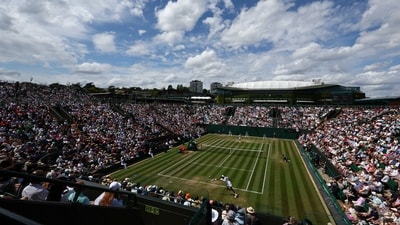
Apart from that, it’s simply tennis. Particularly so in India, the place grass-court tennis, seeped in historical past and soaked in opulence, has all however disappeared. The Davis Cup tie between India and Denmark final yr on the grass courts of Delhi Gymkhana Membership was a breath of recent air within the barren panorama of enjoying, and watching, tennis on grass within the nation.
Which, within the many years passed by, resembled a buzzing hive. Grass had been greener in Indian tennis from a century in the past, proper from when the All India Garden Tennis Affiliation was shaped (it's now simply All India Tennis Affiliation). The nation would host two separate nationwide championships, one completely on grass that was first held in 1946 on the famed South Membership in Kolkata (then Calcutta). Made richer by its international flavour — some high stars of world tennis spent their winters enjoying on the grass courts of India.
Its champions have been a lot celebrated: from Sumant Misra and Ramanathan Krishnan, to two-time Wimbledon champion Roy Emerson of Australia and Romania’s former world No.1 Ilie Nastase, to Premjit Lal, Vijay Amritraj, Ramesh Krishnan and Mukerjea.
All of them took their craft to numerous cities of the nation that hosted, other than the distinguished Asian Championships, a well-carved home circuit on grass.
“These days, there have been solely grass or clay courts, no artificial courts,” Mukerjea, who made the final 16 at Wimbledon 4 instances, says. “We grew up enjoying lots on grass. Most of our tournaments have been on grass. Most of our nice wins got here on grass. The grass circuit started in November and travelled to locations like Amritsar, Delhi, Lucknow, Kolkata, Allahabad, Jaipur. We then switched to clay or laborious courts.”
Kolkata’s South Membership could be a particular serving in that elaborate grass unfold. With 12 courts of the pure inexperienced “thought of subsequent to Wimbledon in these days”, as Bengal Tennis Affiliation CEO Sujoy Ghosh mentions, catching some serve-and-volley deal with on that hallowed turf was bon appetit for tennis followers within the nation.
“Folks used to hold their towels courtside as a mark of reserving,” Ghosh recollects. “As a child, I nonetheless bear in mind the factors of Roy Emerson beating Ramanathan twice within the last in South Membership. We might watch these gamers play on grass with awe. Even stepping on to the court docket was a giant deal for us.”
Additionally, a giant deal was Indian gamers’ outcomes on the floor, individually and collectively. Apart from the Krishnans and Amritraj making deep runs at Wimbledon, a few of Indian tennis’ red-letter triumphs in Davis Cup got here on grass: from the legendary 1966 inter-zonal last turnaround story in opposition to Brazil at South Membership to the long-lasting tie in opposition to Pakistan at Mumbai's Cricket Membership of India 4 many years later.
For that much-anticipated Pakistan duel in his dwelling metropolis, Leander Paes, Ghosh narrates, sought the experience of a gardener of South Membership, in not simply changing the cricket stadium right into a makeshift tennis floor but additionally rolling the grass as per the hosts’ style.
“So myself, our affiliation secretary and the maali stayed at CCI for about three weeks to arrange the court docket,” Ghosh recollects. “Leander informed us to make it (the floor) sluggish, in order that Aisam ul-Haq Qureshi’s serve from one aspect might be negated a bit. We rolled the floor accordingly, with a slight slope from left to proper.”
India clinched that tie 3-2 with Paes and Mahesh Bhupathi weaving their magic on grass and galvanizing a era with triumphs like these. “My first reminiscences of watching tennis on grass stay was the Davis Cup matches in Delhi...watching Leander, Mahesh all through the years, profitable a number of Davis Cup matches for the nation,” Yuki Bhambri, India’s former junior world No.1, says.
Bhambri, 31, received an ATP doubles title on grass at Mallorca within the week main as much as Wimbledon, the place, partnering Saketh Myneni, he misplaced within the first spherical. There was no Indian within the Wimbledon singles draw this time, just one within the qualifying. For the present Indian gamers who've little expertise of coaching or competing on grass, that's hardly a shock.
“Most academies and golf equipment, particularly in India, have much more laborious courts now,” Bhambri says. “Not simply me, for each participant, it’s laborious to adapt to grass. The courts at Wimbledon have modified too and are lots slower, which provides to the problem.”
From its double-digit excessive, South Membership is now left with solely six grass courts. From 2008 to the current, India have hosted solely 5 Davis Cup ties on grass, whereas all ATP and ITF tournaments within the nation are held on laborious or clay courts. The arrival and recognition of all-weather laborious courts, coupled by the excessive upkeep course of and value of grass courts for season-specific use, signalled a fast decline.
It mirrors a extra world phenomenon of a altering recreation and tools. “Grass-court tennis was principally serve-and-volley, which was good to look at. Now in the event you see, even at Wimbledon, they’re all hitting from the again of court docket. I’m not saying that’s unhealthy, however that’s how a lot the sport has modified,” Mukerjea says.
“I miss grass-court tennis,” he provides. “However so long as Wimbledon is there, it will likely be alive.”
In India, save the odd Davis Cup tie, it's useless. “We have now to neglect about grass courts in India," Ghosh says. “Simply look ahead to Wimbledon annually for the eyes.”
And for the reminiscences.
[ad_2]
No comments:
Post a Comment